Ryan McVey profile photo

2-Min Overview

ABOUT ME

I'm Ryan McVey — Innovative Technology Architect specializing in Cloud, AI, and Hybrid Infrastructure. I design practical, secure, and scalable technology systems that connect strategy to execution. My background spans public sector, private sector, and military environments, with more than 20 years of experience across systems administration, application modernization, cloud architecture, observability, governance, and AI-enabled solution design.

Today, my work centers on hybrid and multi-cloud architecture, SDLC modernization, platform governance, and responsible AI adoption. I focus on helping organizations move beyond one-time migration efforts into durable operating models that improve security, compliance, delivery speed, cost visibility, and long-term resilience.

Rooted in Service

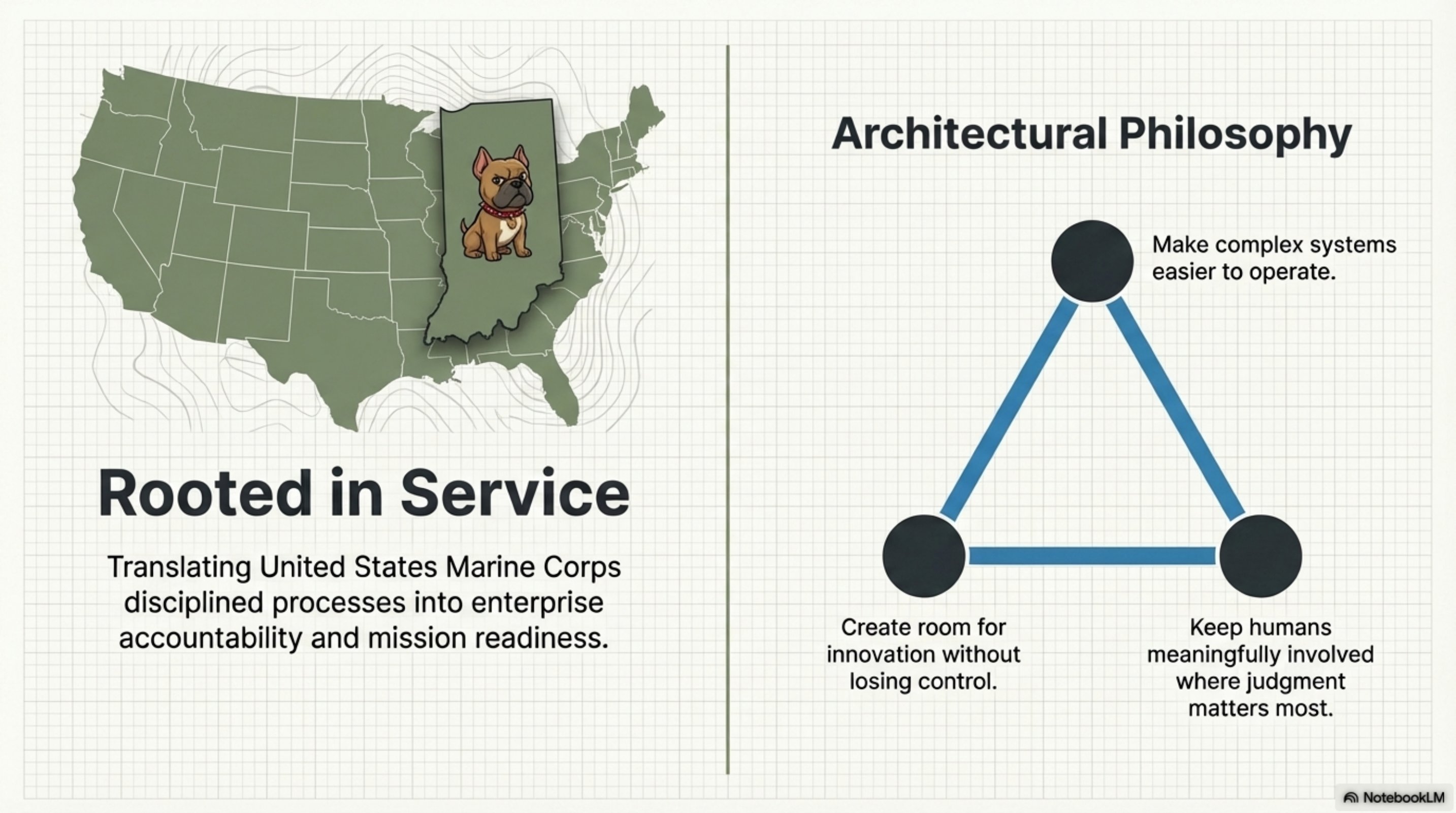
My career began with service in the United States Marine Corps, where I developed a strong foundational understanding of technology principles, disciplined processes, and governance standards. That early experience shaped a career-long commitment to accountability, mission readiness, and structured problem-solving — themes that have carried through the majority of my work in government and technology fields.

Today, service remains a defining part of my family's life. My spouse is an active-duty Navy sailor currently training as a Hospital Corpsman. Commitment to service is a choice — and one I plan to keep choosing.

Core Skills

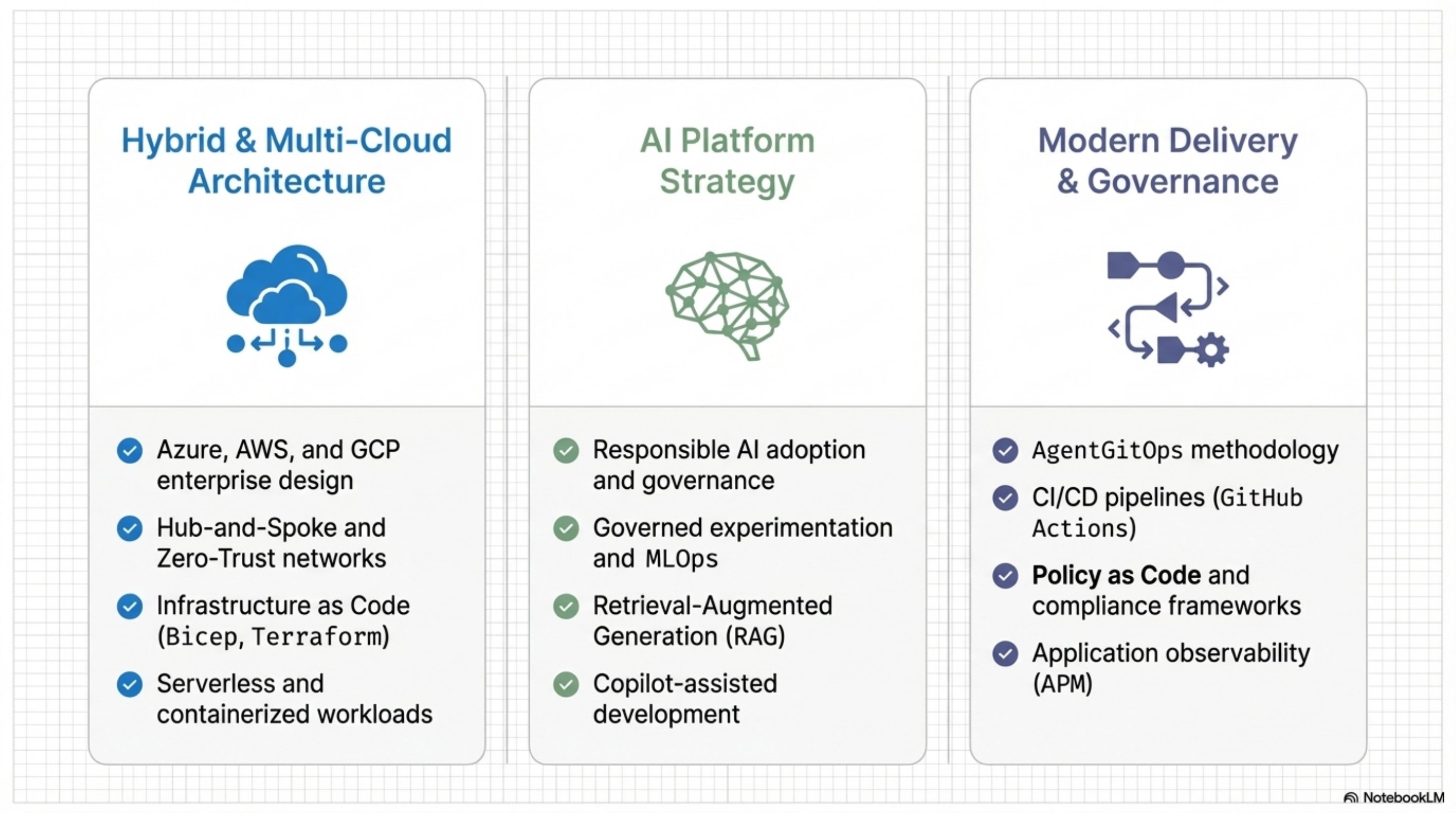
  • Cloud & Infrastructure: Azure, hybrid/multi-cloud architecture, IaC (Bicep, Terraform), serverless, containers
  • DevOps & Delivery: CI/CD (GitHub Actions), GitOps, SDLC modernization, platform engineering
  • Governance & Security: Policy as code, compliance frameworks, identity management, zero-trust design
  • AI & Automation: Responsible AI adoption, Copilot-assisted development, intelligent automation
  • Leadership: Technical strategy, cross-functional delivery, stakeholder alignment, mentorship

Philosophy

I believe strong architecture should do three things well:

  • Make complex systems easier to operate
  • Create room for innovation without losing control
  • Keep humans meaningfully involved where judgment matters most

Beyond Architecture

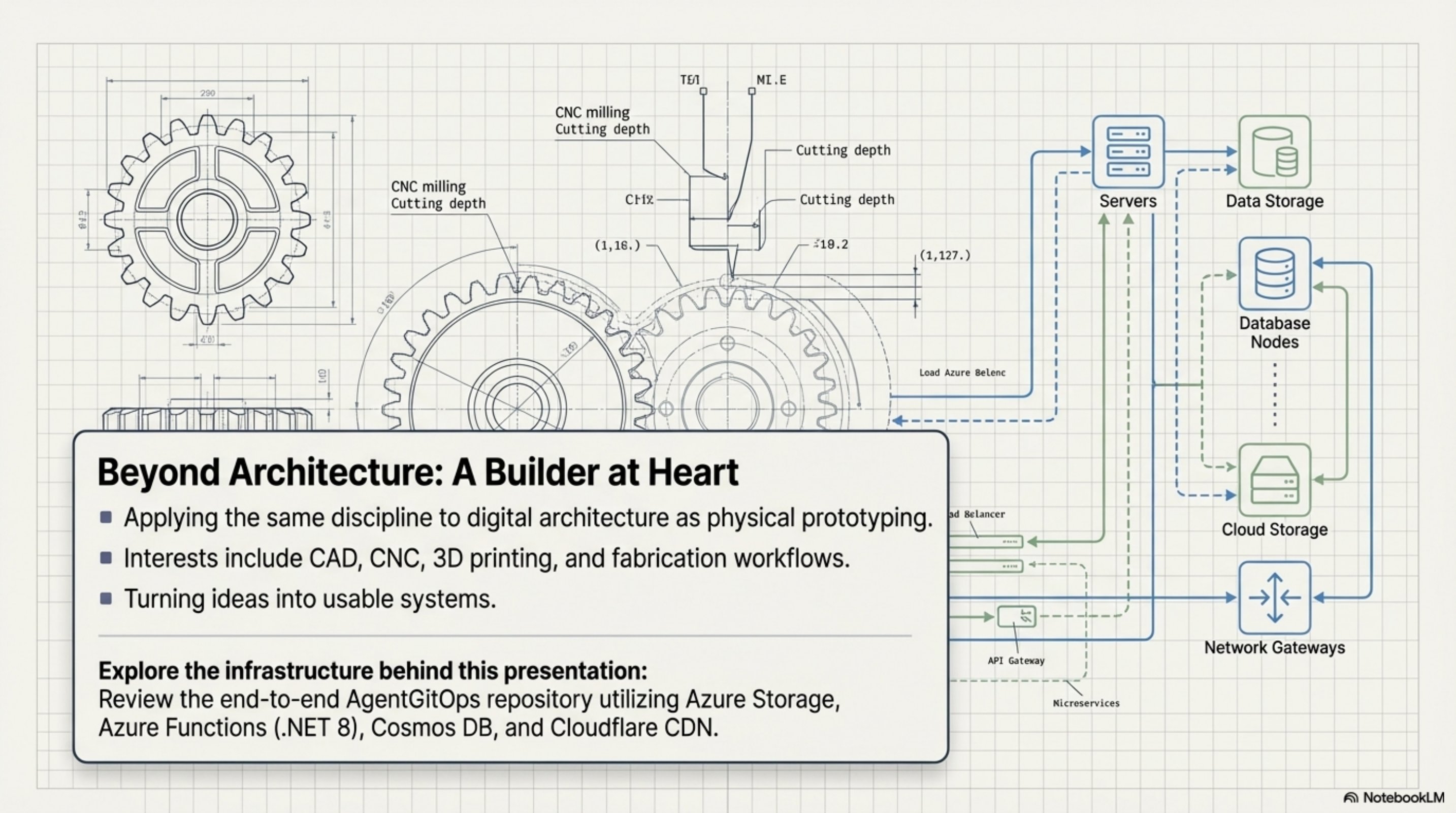
I am a builder and tinkerer at heart. My interests include CAD, CNC, 3D printing, fabrication workflows, and turning ideas into usable systems and physical prototypes.

This page is inspired by the Cloud Guru Azure Resume Challenge and is being modernized end-to-end using AgentGitOps.

From Service to Architecture

Listen to the full story of my professional journey — from USMC tactical data systems to enterprise cloud architecture.
22 min

Experience

Indiana Office of Technology

Cloud Solutions Enterprise Architect October 2018 - Present

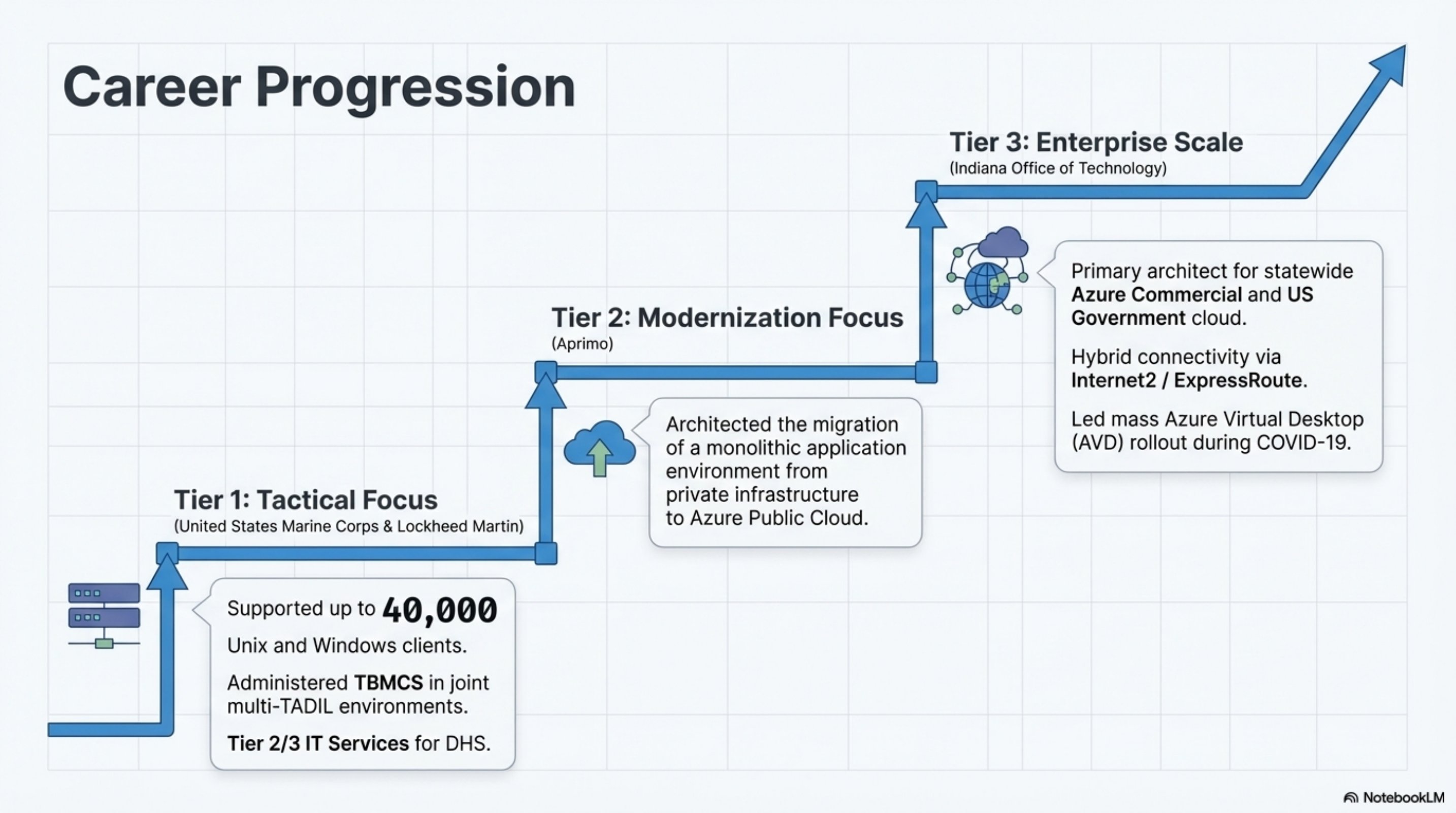
  • Primary solutions architect for Azure Commercial and Azure US Government cloud identity, networking, and governance.
  • Designed hub-and-spoke network model enabling hybrid connectivity via Internet2 / ExpressRoute private peering.
  • Led Azure Virtual Desktop rollout for thousands of state employees during COVID-19.
  • Technical advisor and escalation point for dedicated cloud operations engineers.

Aprimo

Azure DevOps Engineer March 2012 - April 2018

  • Cloud DevOps Engineer modernizing monolithic application architecture from private cloud to Azure Public Cloud.

Lockheed Martin

IT System Administrator September 2008 - January 2012

  • Tier 2 and Tier 3 IT Services support for the Federal Department of Homeland Security (DHS).

United States Marine Corps

Tactical Data Systems Administrator (MOS-5974) October 2003 - December 2007

  • Subject Matter Expert for Theater Battle Management Core System (TBMCS) and Perimeter Security System (PSS), supporting up to 40,000 Unix and Windows clients.
  • Operated and tested tactical data links in the Marine Tactical Air Command Center in a joint multi-TADIL environment.

Expertise

Current Focus

  • Building and maturing statewide cloud and AI capabilities in complex enterprise environments
  • Advancing software delivery standards and platform governance for custom application teams
  • Applying AI and workflow automation to practical business and operational use cases
  • Demonstrating modern architecture patterns through hands-on project work, prototypes, and structured technical documentation

Areas of Practice

  • Cloud & Hybrid Architecture — Azure, AWS, GCP, and traditional enterprise infrastructure
  • AI Platform Strategy — Governed experimentation, enterprise AI services, indexing, and applied ML workflows
  • Adaptive Agent Workflows — Human-in-the-loop design for reliability, safety, and operational usefulness
  • SDLC Modernization — Policy-driven platforms, IaC, CI/CD, and delivery guardrails
  • Application Observability — APM integration for performance, supportability, and operational maturity
  • Enterprise Governance — Security, compliance, cost accountability, and scalable service delivery

Certifications

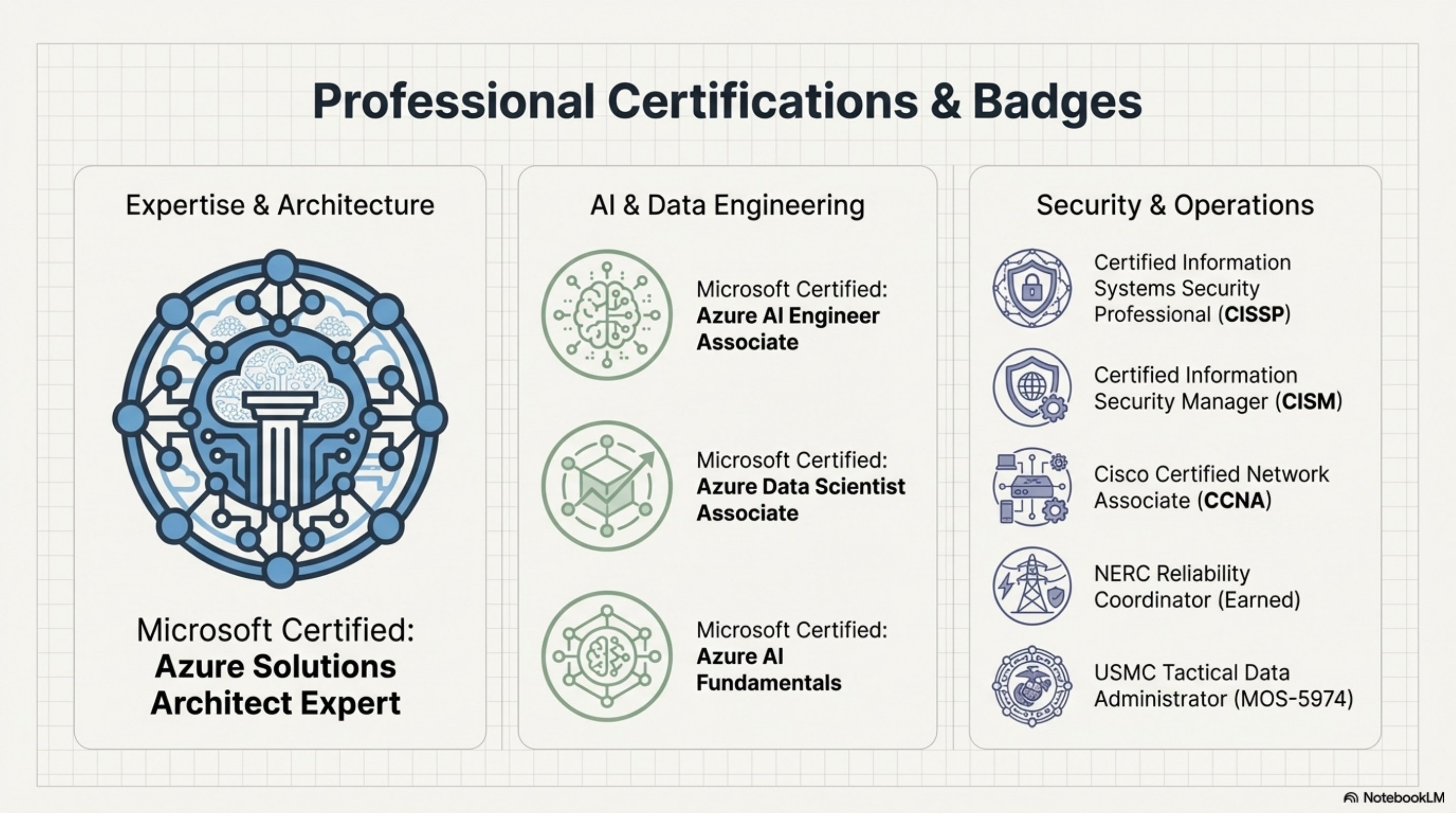
Microsoft Certified: Azure Solutions Architect Expert

December 2021 - Present

Verify Credential

Azure Solutions Architect Expert badge

Microsoft Certified: Azure AI Engineer Associate

2024 - Current / Active

Verify Credential

Microsoft Certified: Azure Data Scientist Associate

2024 - Current / Active

Verify Credential

Microsoft Certified: Azure AI Fundamentals

2024 - Current / Active

Verify Credential

USMC Tactical Data Administrator (5974)

Military Service

MOS Description

Administered and maintained C4I tactical data systems in joint operational environments, including TBMCS (Theater Battle Management Core System), CAC2S (Common Aviation Command & Control System), AFATDS (Advanced Field Artillery Tactical Data System), and ADSI (Air Defense Systems Integrator).

Equivalent Civilian Certifications (Marine Corps COOL):

NERC Reliability Coordinator

Past - Not Active (Earned)

Operator Reference Guide  |  Certification Exam Statistics

Education

United States Marine Corps

Tactical Data Systems Technology (MOS-5974) January 2003 - January 2007

Formal military technical training in tactical data systems administration, network infrastructure, and secure communications supporting joint operations environments.

Infographic

A visual overview of my professional background, skills, and career journey.

Ryan McVey Professional Infographic

AgentGitOps

AI-Driven Project Delivery

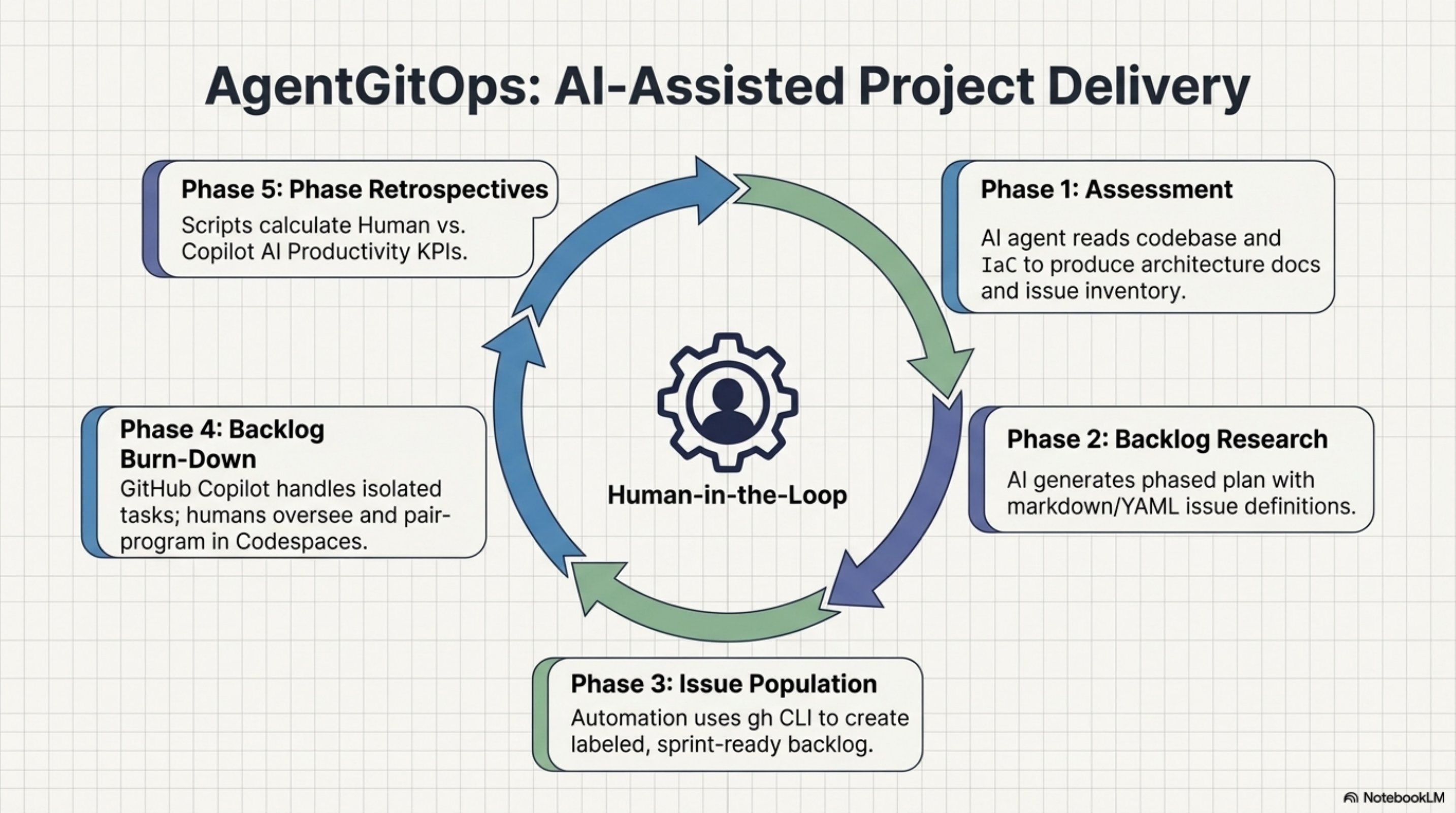
This resume site is being modernized end-to-end using AgentGitOps — a methodology that combines GitHub Copilot coding agent, GitHub Issues, GitHub Projects, and GitHub Actions workflows to deliver infrastructure and application changes through an AI-assisted, human-supervised pipeline.

How It Works

The approach follows a structured, multi-phase workflow:

  • Assessment — An AI agent reads the entire codebase, IaC templates, workflows, and configuration to produce architecture documentation, assessment CLI commands, and a known-issues inventory.
  • Backlog Research — The agent generates a phased backlog plan with individual issue definitions stored as markdown files with YAML frontmatter, enabling scripted label extraction and creation.
  • Issue Population — Automation scripts create GitHub labels, milestones, and issues via the gh CLI, producing a fully labeled, project-tracked backlog ready for sprint planning.
  • Backlog Burn-Down — Issues labeled Copilot: Yes are assigned to the GitHub Copilot coding agent, which creates feature branches, implements changes, and opens pull requests. Copilot: Partial tasks are worked collaboratively in Codespaces with human oversight.
  • Phase Retrospectives — At each phase boundary, a retrospective script collects issue, PR, and commit statistics to calculate Human vs. Copilot AI Productivity KPIs, tracking AI leverage at both the task level and commit level.

The Human-Intent-First Approach

AgentGitOps is not simply about placing humans in a review-and-validate loop at the end of an AI workflow. The defining principle is that humans set the intent, goals, and success criteria at the very start of any meaningful effort — before a single agent session begins or a single line of code is written. The AI operates within that human-defined structure, not alongside it after the fact.

Session 0 is the mechanism that makes this concrete: a structured conversation between the project owner and an AI planning agent. The human articulates what they want to achieve, when, and why. The agent translates that into a phased backlog, milestone plan, and issue taxonomy — a shared artifact that every subsequent automated session references. The backlog becomes the contract between human intent and AI execution, and every phase retrospective measures delivery against the goals the human defined at the outset.

This makes AgentGitOps a practical and cost-effective way to experience AI-assisted delivery in action for small to medium efforts — a single developer or small team can run a complete structured delivery cycle with measurable Human vs. AI productivity KPIs. The same modular, phase-based approach scales equally well to large-scale efforts: the structured assessment and scoping process provides a rigorous foundation for estimating complexity, identifying risk, and planning work that would otherwise be difficult to scope accurately before committing resources.

Bootstrap for Any Repository

The AgentGitOps workflow is designed to be repository-agnostic. The same backlog builder pattern can be applied to any new or existing repository for:

  1. Application framework upgrades (e.g., .NET Core 3.1 → .NET 8)
  2. Cloud service provider migrations (e.g., Azure CDN → Cloudflare)
  3. Security hardening and compliance remediation
  4. Cost optimization and resource right-sizing
  5. Greenfield project scaffolding with structured delivery phases

Getting started takes just three steps: copy the bootstrap/ directory into your repository, open a GitHub Codespace with Copilot in Plan mode (Claude Opus 4.6), and paste in the Session 0 prompt. The agent asks for your project goals, phases, and timeline — then populates all scripts and creates the initial backlog automatically. No manual script editing required.

Applied to This Site

This azure-resume-iac repository uses the AgentGitOps workflow across six phases: Assessment, Fix Function App, Content Update, Dev Deployment, Prod Deployment, and Cleanup & Docs. The project backlog includes 59+ issues with structured labels for phase, priority, size, area, and Copilot suitability — enabling filtered views for sprint planning, roadmap tracking, and an AI task queue.

Key project infrastructure includes:

  • Azure Bicep IaC targeting Azure Functions (.NET 8), Cosmos DB, Key Vault, and Storage Accounts
  • Cloudflare CDN with WAF for origin protection and geo-restricted access
  • GitHub Actions CI/CD with path-filtered workflows for backend, frontend, and infrastructure
  • GitHub Projects (V2) with custom fields for Phase, Priority, Size, and Copilot Suitability

Projects

Enterprise CI/CD Platform Strategy

Developer Enablement & Governance Ongoing

Led long-term standardization of state delivery platforms, beginning with an Azure DevOps multi-organization strategy and evolving toward GitHub Enterprise Cloud core services that enable governed adoption of GitHub Copilot at scale. Drove developer enablement, enterprise governance, and secure SDLC modernization across executive agency engineering teams.

Indiana DOE Ed-Fi Replatforming

Azure PaaS & Platform Engineering Completed

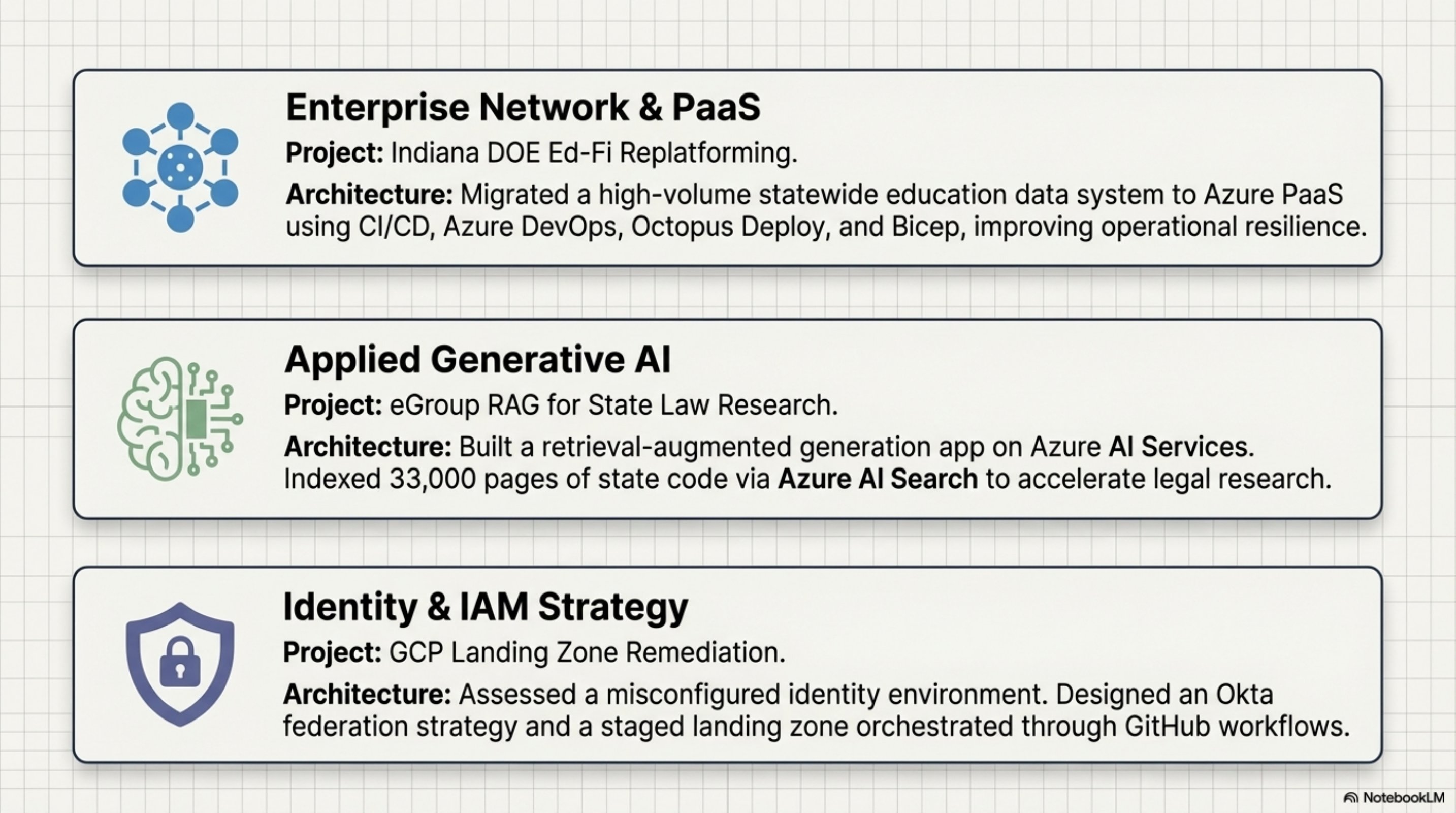
Architected the migration of a major Ed-Fi-based education data system from traditional infrastructure to Azure PaaS delivery using CI/CD pipelines, Azure DevOps, Octopus Deploy, ARM, and later Bicep. Improved deployment reliability and operational resilience for a high-volume state system serving thousands of schools statewide.

Google Identity / GCP Landing Zone Remediation

Cloud Identity & IAM Strategy Completed

Assessed a misconfigured Google identity environment with hundreds of unmanaged users, then planned a corrected IAM strategy centered on Okta federation, Google Cloud organization hierarchy, and workload alignment by agency and environment tier. Designed a Cloud Foundation Fabric FAST-style staged landing zone deployment orchestrated through GitHub workflows.

Azure Hub-and-Spoke Enterprise Network Strategy

Enterprise Cloud Governance Ongoing

Designed enterprise Azure management group and hub-and-spoke architecture with centralized connectivity, shared services, policy alignment, and workload isolation across landing zones. Established scalable governance patterns and repeatable enterprise cloud design supporting multiple agency workloads.

eGroup RAG for State Law Research

Applied Generative AI & Search Completed

Built a retrieval-augmented generation application on Azure AI Services, adapted from a Postgres/OpenAI sample to index approximately 33,000 pages of Indiana State Code PDFs. Extended the architecture with a California State Code variant that converted database objects into document-style embeddings for Azure AI Search-backed chat retrieval, accelerating legal research and improving search relevance.

Azure ML Stock Model Training

Machine Learning & MLOps Completed

Developed an Azure Machine Learning workflow that trained market models from ticker stream data and produced serialized .pkl artifacts for downstream inference. Managed experiment execution, model registration and versioning, and practical ML pipeline design within Azure ML Studio.

azure-resume-iac

Azure PaaS Resume Site with AgentGitOps Active

End-to-end infrastructure-as-code and application delivery for this resume site, built on Azure Storage, Azure Functions (.NET 8), and Cosmos DB with Cloudflare CDN. Demonstrates the AgentGitOps backlog builder workflow with phased delivery, GitHub Copilot coding agent integration, and automated phase retrospectives tracking Human vs. AI productivity KPIs.

Presentation

Professional Overview Slides

A slide deck summarizing my career highlights, technical expertise, and professional accomplishments.

  • Slide 1 — Title: Ryan McVey, Cloud & AI Solutions Architect
  • Slide 2 — Professional Overview
  • Slide 3 — Technical Expertise
  • Slide 4 — Career Highlights
  • Slide 5 — Key Accomplishments
  • Slide 6 — Solutions Architecture
  • Slide 7 — Cloud & AI Strategy
  • Slide 8 — Summary & Contact
1 /